 Reviewed by
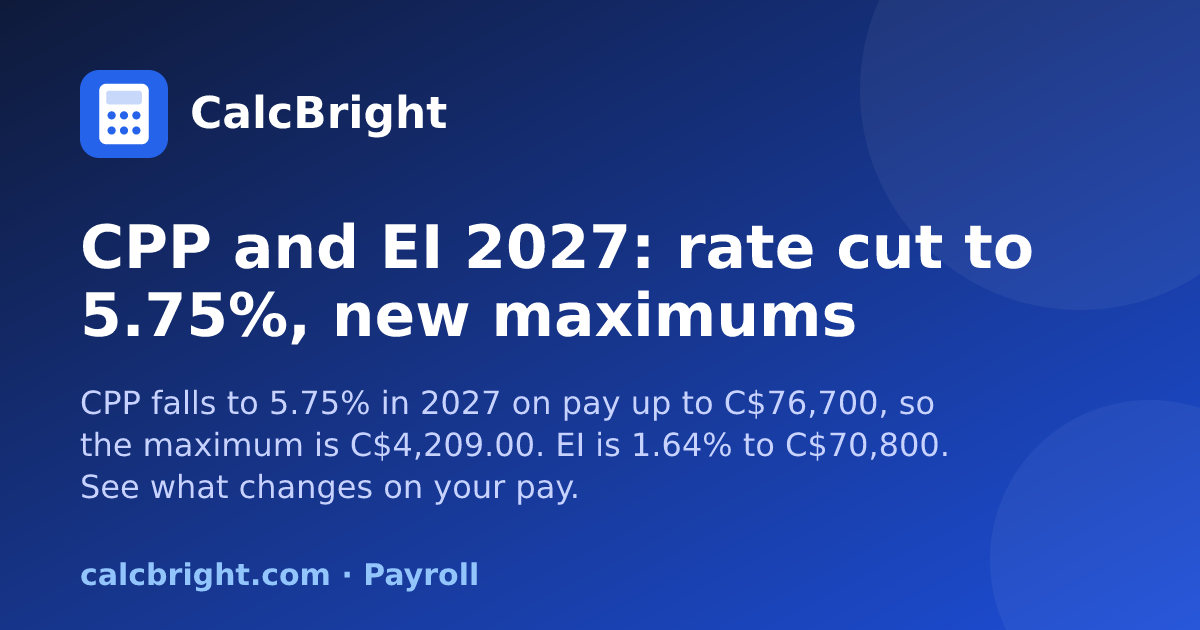
The Canada Revenue Agency has posted the 2027 Canada Pension Plan figures, and the headline is unusual: the contribution rate goes down. From 1 January 2027 employees pay 5.75% instead of 5.95% on pensionable earnings. At the same time the earnings ceilings rise with wages, and the Employment Insurance premium edges up. The result is that most people pay a little less, while people earning above the new ceilings pay a little more. We ran both years through the same contribution code our take-home pay calculator uses.
What changes on 1 January 2027
- CPP rate: the base rate falls from 4.95% to 4.75% each for employee and employer, so the combined base and first additional rate drops from 5.95% to 5.75%. The cut was made by Bill C-30, which received Royal Assent in June 2026.
- CPP ceiling (YMPE): C$76,700, up from C$74,600. The first C$3,500 stays exempt. Maximum employee contribution: C$4,209.00 (was C$4,230.45).
- CPP2: still 4%, now on earnings from C$76,700 to C$87,400 (was C$74,600 to C$85,000). Maximum: C$428.00 (was C$416.00).
- EI: 1.64% (C$1.64 per C$100) up to C$70,800 of insurable earnings, up from 1.63% and C$68,900. Maximum employee premium: C$1,161.12 (was C$1,123.07).
All told, the most an employee can pay in CPP, CPP2 and EI rises from C$5,769.52 to C$5,798.12. Quebec workers pay into the Quebec Pension Plan and a lower EI rate instead, so these figures do not apply to them.
Who pays less and who pays more
A lower rate helps everyone below the old ceiling. Above it, the higher ceilings add contributions that outweigh the rate cut. Using the 2026 and 2027 figures, the crossover sits at about C$86,685 of employment income: below that you pay less in 2027, above it a little more.
| Salary | CPP + CPP2 2026 | CPP + CPP2 2027 | EI 2026 | EI 2027 | Change per year |
|---|---|---|---|---|---|
| C$40,000 | C$2,171.75 | C$2,098.75 | C$652.00 | C$656.00 | −C$69.00 |
| C$60,000 | C$3,361.75 | C$3,248.75 | C$978.00 | C$984.00 | −C$107.00 |
| C$75,000 | C$4,246.45 | C$4,111.25 | C$1,123.07 | C$1,161.12 | −C$97.15 |
| C$85,000 | C$4,646.45 | C$4,541.00 | C$1,123.07 | C$1,161.12 | −C$67.40 |
| C$100,000 | C$4,646.45 | C$4,637.00 | C$1,123.07 | C$1,161.12 | +C$28.60 |
| C$150,000 | C$4,646.45 | C$4,637.00 | C$1,123.07 | C$1,161.12 | +C$28.60 |
The salary links open our take-home pay calculator for Ontario, which shows the 2026 deductions until 1 January.
Worked example: C$75,000 and C$100,000
On C$75,000 in 2026 you pay C$4,246.45 in CPP and CPP2 – 5.95% of the C$71,100 between the exemption and the ceiling, plus 4% of the C$400 above it – and C$1,123.07 in EI, the 2026 maximum. In 2027 your whole salary sits below the new ceiling, so CPP is 5.75% of C$71,500, or C$4,111.25, with no CPP2. EI rises to C$1,161.12 because the insurable maximum went up. Net effect: C$97.15 less for the year.
On C$100,000 you hit every ceiling in both years. CPP falls from C$4,230.45 to C$4,209.00, but CPP2 rises from C$416.00 to C$428.00 and EI from C$1,123.07 to C$1,161.12. You pay C$28.60 more – the rate cut is smaller than the effect of the higher ceilings. On C$40,000 the saving is C$69.00.
One side effect: base CPP contributions earn a 14% federal tax credit, so a smaller base contribution means a slightly smaller credit. The 2027 federal tax brackets are indexed separately; we will apply them, and these contribution figures, in the calculator on 1 January.
What it means for Gulf returnees and employers
If you are weighing a Gulf job against a Canadian one, the comparison barely moves: contributions change by tens of dollars a year at typical salaries. For employers, the matching CPP falls in step with the employee rate, while the maximum employer EI premium rises to about 1.4 times the employee amount. Self-employed people pay both halves of CPP, so their maximum falls from C$8,460.90 to C$8,418.00 before CPP2.
What to do now
- Nothing for your paycheque: payroll software switches to the 2027 rates and maximums with the first pay of January.
- If you earn more than C$76,700, expect your CPP and CPP2 deductions to stop slightly later in the year than in 2026.
- Self-employed? Use 11.5% on net earnings up to the ceiling when you set aside money for 2027 instalments.
- Working for two employers? Each one deducts up to the maximum; claim any overpayment back on your 2027 return.
How we calculated this
2026 figures come from our take-home pay calculator. For 2027 we changed only the published rates and limits: CPP 5.75% to C$76,700 with a C$3,500 exemption, CPP2 4% to C$87,400, EI 1.64% to C$70,800. Employment income only, one employer, outside Quebec; income tax is not included. Sources: Canada Revenue Agency – CPP contribution rates, maximums and exemptions; CRA – CPP2 rates and maximums; Canada Employment Insurance Commission – 2027 premium rate.
General information, not tax advice. Your own deductions depend on your pay pattern, province and employers; check CRA guidance or a professional for your situation.